[August 2026]
Global precision manufacturing and high-end supply chains are undergoing a paradigm shift toward digital and flexible production processes. Faced with the dual pressures of historically high precious metal prices and a severe shortage of skilled mold-repair artisans, traditional manufacturing workshops are confronting unprecedented challenges regarding efficiency, spatial utilization, and comprehensive quality control. Powered by precise digital code control, MJP (Multi-Jet Printing with pure wax) technology is emerging as a core driving force-reshaping the landscape of profit distribution within the precision casting industry through a transformative, game-changing impact.
I. Market Overview: Simultaneous Expansion Across Three Key Markets; Wax Pattern Printing Emerges as a Core Growth Engine
In 2026, the global 3D-printed jewelry market continued to reap the benefits of robust asset expansion. Authoritative auditing bodies both domestically and internationally released updated figures for the fiscal year:
Mordor Intelligence: Statistics indicate that the global 3D-printed jewelry market grew steadily from $870 million in 2025 to $980 million in 2026. Long-term forecasts project the market will reach $2.03 billion by 2031, with a Compound Annual Growth Rate (CAGR) of 12.33%.
Research and Markets: Data shows the market size stood at $4.17 billion in 2025 and surged to $4.89 billion in 2026, reflecting a CAGR of 17.3%.

Fact. MR: Offered a more aggressive macro-forecast, estimating the 2026 global market valuation at $1.8 billion and projecting it to reach $7.4 billion by 2036. Within the materials segment, resins and wax-pattern materials commanded a dominant 41% share of the total market in 2026; notably, investment casting wax patterns accounted for 44% of that specific segment. This significant market weighting underscores a disruptive reality for the industry: the underlying logic of so-called "gold 3D printing"-currently used in high-end global jewelry manufacturing and the processing of advanced industrial components-is not the direct laser melting of precious metals (a process plagued by high costs and material instability). Instead, it relies on a flexible hybrid process combining "high-precision 3D-printed wax patterns" with "traditional lost-wax precision casting." This technological approach perfectly marries the micron-level geometric freedom of additive manufacturing with the maturity and reliability of traditional lost-wax casting.
The global investment casting market is simultaneously undergoing rapid, broad-based expansion. Data from Mordor Intelligence indicates that the market was valued at approximately $17.53 billion in 2025, is projected to reach $18.45 billion in 2026, and is expected to grow to $23.82 billion by 2031. Industry reports clearly indicate that additive manufacturing technology is accelerating the transformation of workflows for mass-produced wax patterns, rapid tooling, and prototyping; this has drastically increased the speed of 3D dimensional design verification for complex geometries and cut development cycles by more than 50%. Sales in the associated global market for wax-jetting 3D printer hardware reached $771 million in 2026 and are projected to double to $1.546 billion by 2032, representing a robust CAGR of 10.6%.
II. Technological Evolution: How MJP Wax-Jetting Became the Gold Standard in the Casting Industry
Currently, in the sectors of high-end custom jewelry and industrial mold making, the two dominant additive manufacturing technologies used to print high-precision, castable wax patterns are MJP (Multi-Jet Printing) and DLP (Digital Light Processing). For professional foundries dedicated to in-house development and maintaining a competitive edge through superior quality, MJP technology has indisputably become the gold standard for precision casting. Its core advantages include:
100% Pure Wax Material with Zero-Ash Burnout: Unlike DLP technology, which uses photopolymer resins, industrial-grade MJP technology employs 100% pure wax-based materials (such as the industry-leading VisiJet series and specialized wax-jetting consumables) for the initial forming stage. During high-temperature mold burnout, these macromolecular organic materials undergo rapid, complete thermal decomposition in situ, leaving behind no harmful ash or carbonized residue; this fundamentally eliminates the risk of micro-cracking in the gypsum mold caused by resin expansion.
Optical-Grade Surface Quality with Drastically Reduced Precious Metal Loss: The printed patterns feature smooth surfaces, fine textures, and exceptional mechanical isotropy. This ensures truly smooth, resistance-free mold filling when molten precious metal is injected under vacuum pressure, significantly reducing the workload for subsequent metal finishing and minimizing precious metal weight loss to the absolute limit.
Post-Processing in Standard 38–42°C Warm Water-100% Manual Scraping Eliminated: MJP technology utilizes water-soluble sacrificial support wax, completely eliminating the need for traditional manual removal of hard supports using knives or shears. Post-processing requires no manual scraping tools; simply place the entire tray of models into a standard warm water bath (38–42°C) -similar to a hot shower-and the white wax dissolves completely at the molecular level within minutes, turning into a milky-white mist that flows away on its own, cutting post-processing time by over 60%.
Extremely Streamlined Data-to-Production Workflow: 3D CAD Model → Digital Intelligent Slicing → Pure Wax Printing → Lost-Wax Casting → Final Metal Part. Design modifications require no remaking of traditional master patterns or positive molds, fundamentally optimizing the overall production cost structure.
III. Industry Trends: Global Giants Compete in Technology; Originator Drives a New Paradigm for Efficient Mass Production
1. 3D Systems: MJP 300W Plus Redefines the Limits of Efficiency and Surface Quality
As the pioneer of MultiJet Printing (MJP) technology, US-based 3D Systems launched the MJP 300W Plus in September 2025, continuing to push the industry's resolution boundaries:
Build Volume: 309 × 211 × 144 mm
Ultra-fine Vertical Layer Thickness: Achieves 8-micron vertical layer thickness in "Premium ZHD" mode; also features QHD (14.1 microns) and XHD (16 microns) modes, capable of completing a full-tray print job with a height of 1 inch in 9.5 hours.
Surface Enhance™ Technology: Significantly improves wax pattern surface finish, reduces polishing time and precious metal loss, increases print speed by over 30% compared to the previous generation, and cuts support material usage by 50%. The system complies with rigorous IEC 62443 and CMMC 2 cybersecurity standards, utilizing local encrypted storage for design files to prevent the leakage of design assets.
2. Flashforge: Dual-Track Advancement in Desktop Breakthroughs and Industrial Flagships
Flashforge has penetrated various market segments with a flexible product matrix and, certified by Shangpu Consulting, achieved the highest global sales volume in 2024:
Desktop Breakthrough (WJ51C): Launched at the Las Vegas Jewelry Show in May 2026. It successfully integrates industrial-grade MJP precision into a compact desktop unit measuring 865 × 510 × 654 mm, with a build volume of 235 × 138 × 100 mm. It boasts a resolution of up to 2900 × 2900 × 1700 DPI and a layer thickness of 15 microns, with a monthly production capacity of 3–4 kg. It features an innovative, independent, split-type wax block system that eliminates the need for repeated heating, directly addressing the pain points of space constraints and high material waste faced by small and medium-sized studios.
Industrial-grade flagship (WaxJet 530): Utilizes a unique parallel scanning architecture with three printheads, equipped with three sets of Xaar piezoelectric printheads. Within a build volume of 289 × 208 × 150 mm, it boosts printing speed to 6.35 mm/h (requiring only 8.2 seconds per layer) and delivers a stable monthly output of nearly 12 kg of high-purity wax patterns.

3. Originator: A three-printhead collaborative architecture driving a new paradigm for efficient mass production
In the domestic industrial-grade MJP wax printing sector, Hangzhou Originator 3D Technology Co., Ltd. (Originator) is accelerating its global market expansion through digital and intelligent transformation, backed by solid technical expertise and a robust product portfolio. The company's core team has over a decade of experience in 3D printing hardware R&D, precision manufacturing of intelligent equipment, and advanced materials for additive manufacturing; they have established a comprehensive product ecosystem covering mainstream technologies such as LCD, DLP, and MJP.
[Technological Moat / Originator ORI 051 & ORI 053 Specification Matrix]
ORI 051 Single-printhead model: Emphasizes high precision, low cost, and ease of operation; perfectly suited for small-to-medium batch, high-detail printing and customization studios.
ORI 053 Three-printhead flagship: Features a parallel collaborative architecture, designed for large-scale, high-efficiency, 24/7 continuous "lights-out" industrial mass production.
In 2026, Originator launched its new-generation industrial-grade mass-production flagship model-the ORI 053. This model utilizes an advanced architecture featuring three printheads working in parallel and in coordination, effectively eliminating the production capacity fluctuations that plague traditional equipment:
Build volume: 290 × 207 × 138 mm (handles full-tray batch production with ease).
High-resolution matrix: 2,900 × 2,900 × 1,700 DPI, with layer thickness precisely fixed at 15 μm.
Dimensional tolerance repeatability: Achieves industrial-grade precision of ±0.04 mm / 20 mm across all axes, with surface roughness as low as 4 μm.
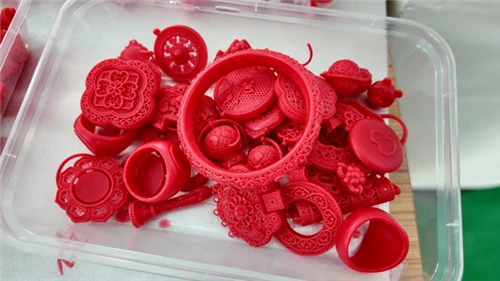
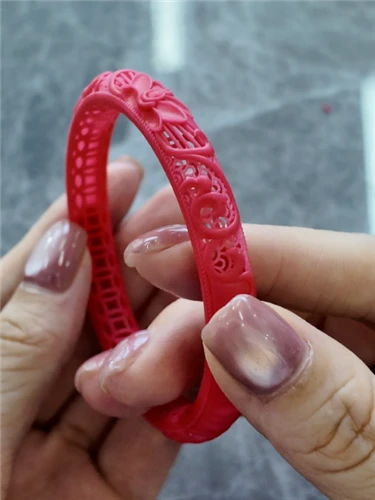
Perfect chemical compatibility between the two materials: Compatible with proprietary ORI-610 red high-purity modeling wax and ORI-110 white water-soluble support wax. The high-contrast red-and-white combination facilitates easy visual quality inspection; the system is supported by ORI3DPrint intelligent slicing software, which securely transmits encrypted binary data streams via the cloud.
In May 2026, Yuanzhu 3D's superior quality control capabilities were rigorously validated by the international market: a delegation of senior procurement engineers from India visited our R&D facility to conduct comprehensive, multi-day blind performance tests and on-site inspections of finished parts produced by the ORI 053. Overseas executives evaluated key metrics, including scanning trajectory stability during high-frequency reciprocating motion, material rheological compatibility, build speed, and part density. Ultimately, the ORI 053 won over the discerning quality control experts with its flawless high-precision printing and exceptional full-tray production yield, leading to the immediate signing of a letter of intent for a long-term strategic partnership. This milestone demonstrates how Chinese-made MJP wax-jetting equipment is capturing major orders within the global high-end precision casting supply chain, driven by outstanding cost-performance and core technological competitiveness.
IV. Technical Challenges and Industry Frontiers: Mastering "Isothermal Control of Thermal Fields" to Overcome Edge Tolerance Drift

Although industrial-grade MJP technology is highly mature, cutting-edge research indicates that during high-volume, full-tray production runs, thermal field anisotropy-the temperature difference between the tray's edge and center-is the primary culprit behind inconsistent local shrinkage of wax patterns at the edges and subsequent dimensional tolerance deviations. Due to higher heat exchange rates between the edge zones and the cold air within the build chamber, wax droplets trap uneven, latent residual stresses during cooling and crystallization; this leads to irreversible deformation and warping of thin-walled structures during subsequent high-temperature investment casting processes.
To eliminate this "hidden scrap tax" that drives up rejection rates for contract manufacturers, the Originator R&D Center systematically re-engineered the equipment's fundamental thermodynamic boundary layer. By integrating a new zoned temperature control array with a PID closed-loop algorithm for millisecond-level thermal load micro-adjustments, the system maintains the entire print surface in a state of absolute isothermality-holding steady at the set temperature ±0.3°C.
With this thermodynamic isotropic protection in place, the high-purity red wax prints require no expensive, high-end chemical cleaning systems. Post-processing staff simply need to use a standard workshop process-soaking or rinsing in warm water at 38–42°C. Within this specific temperature window, the white ORI-110 support wax undergoes complete, molecular-level dissolution and detachment in situ within minutes. Meanwhile, the ruby-red ORI-610 structural wax remains gently enveloped by the warm water, ensuring zero surface abrasion from external force and zero deformation from thermal shock. This secures a first-pass success rate of over 99.8% for final precious metal vacuum-pressure investment casting-a benchmark of industrial excellence.
V. Outlook
As of 2026, MJP wax-jetting 3D printing technology stands at a critical juncture, transitioning from a "high-end customization tool" to "infrastructure for mass production." Amid a brutal industrial landscape characterized by soaring precious metal prices, surging demand for personalization, and ever-tightening delivery schedules, Originator is redefining the industrial paradigm of precision manufacturing and aerospace mold making. We combine a down-to-earth, straightforward approach with a fleet of high-performance hardware that delivers exceptional cost-efficiency.
High-Conversion Lead Magnet (Direct Inquiry Channel for High-Value Orders):
💎 Meeting the world's highest MJP technical standards for 2026, we help you reclaim workshop net profits through a simple warm-water cleaning process:
[Click here to download the "Originator ORI 053 Industrial Triple-Head Wax-Jet Printer: Hardware Specifications & Factory Manager's Cost-Reduction Whitepaper"] or send your sensitive CAD designs directly to our expert digital portal to secure your factory-direct allocation for the new season's overseas fleet procurement and claim a spot for free online sample testing!