Industry Insights | Process Control in MJP Wax Patterning
As high-speed industrial MJP wax patterning scales into high-density build tray production, maintaining micron-level dimensional repeatability across the entire build platform has become a critical process challenge. Even when engineering teams use generative AI and intelligent CAD workflows to design complex geometries-such as continuous micro-claw structures or multi-layered, interlaced hollow-filament networks-final castings may still exhibit micron-scale dimensional deviations that cannot be fully explained by downstream alloy shrinkage.
Comprehensive metrological scanning shows that some of these deviations originate during the high-frequency jetting phase. Residual pressure oscillations and acoustic resonances within the pump chamber can disrupt droplet breakup at the nozzle meniscus, producing trailing micro-droplets-known as satellite droplets-alongside the primary droplets. In MJP wax systems, satellite droplets cause uneven local deposition, inconsistent droplet coalescence, and directional shrinkage variation within the wax pattern, ultimately compromising full-tray dimensional consistency.
To discuss droplet formation stability or sample validation, contact our applications engineering team: Request a Technical Consultation.
Meniscus Instability and Satellite Droplet Formation: Sources of Error During the Jetting Phase
Industrial MJP wax printing relies on piezoelectric printheads to eject micron-scale molten wax droplets at high frequency. The drive waveform-the programmed electrical signal applied to each piezoelectric actuator-governs chamber pressure dynamics, meniscus motion, droplet breakup, and droplet velocity. In wax patterning, droplets undergo rapid thermal solidification upon landing; therefore, any inconsistency in velocity or size is effectively "frozen" into the layer, with no opportunity for smoothing through subsequent spreading.

Under unoptimized static drive waveforms, residual meniscus oscillations can trigger satellite droplet formation, trajectory deviation, and irregular local deposition. For high-value investment casting patterns, these effects go beyond print quality: they can cause uneven droplet coalescence between adjacent print paths, line-width variation, and differential shrinkage between tray center and edge zones-errors that are difficult to correct after casting.
Active Drive Waveform Calibration and Droplet Placement Compensation
To address these jetting instabilities, Originator 3D has integrated an active drive waveform calibration framework into the ORI 053 PLUS industrial-grade MJP wax platform. Using closed-loop telemetry and encoder feedback, the control system dynamically adjusts piezoelectric pulse profiles in real time-including pulse amplitude, rise/fall times, and dwell/retract segments-aligning pulse dynamics with printhead carriage motion to suppress satellite droplet formation.
By cross-referencing a pre-calibrated positional deviation map, the system adjusts droplet ejection velocity against the real-time coordinates of the printhead carriage. In customer validation scenarios, this approach has reduced droplet placement error to below ±0.02 mm.
ORI 053 PLUS platform specifications include:
Build Volume: 290 × 207 × 138 mm
Resolution and Layer Thickness: 2,900 × 2,900 × 1,700 DPI; 15 μm layer thickness
Dimensional Accuracy: ±0.04 mm / 20 mm
Throughput: Up to 100% increase in continuous production capacity, depending on geometry and process parameters
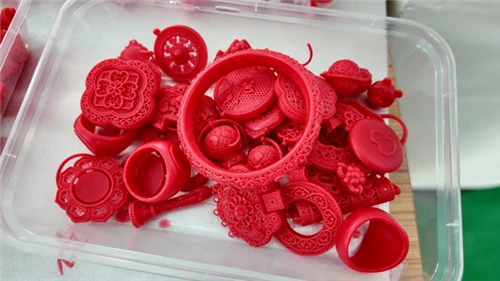
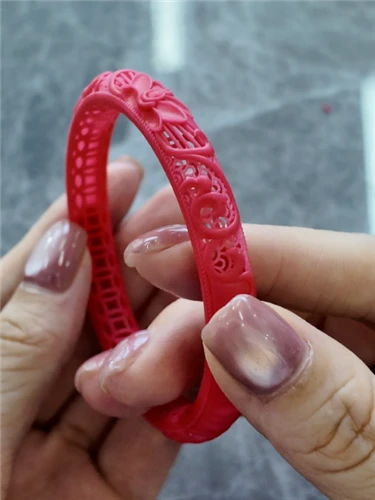
These capabilities are designed to support high-density tray production and improve full-field dimensional consistency, particularly for complex jewelry and precision-component wax patterns.
Standard Ethanol–PPG–Isopropanol Support Removal and Casting Yield
The platform uses a combined solvent cleaning process for support removal based on ethanol, polypropylene glycol (PPG), and isopropanol (IPA). This process enables batch removal of support material from overhanging structures, internal channels, and confined spaces such as delicate prong settings. It minimizes manual tool intervention and reduces the risk of mechanical damage to thin-walled or intricate features.
Because the process involves an organic solvent system, post-processing requires careful control of solvent ratio, cleaning temperature, cleaning time, solvent residue, and drying completeness. These controls help maintain wax pattern surface integrity and support stable shell-building performance.
In customer-validated mass-production scenarios-when paired with standardized cleaning and post-processing protocols-this integrated workflow has been reported to achieve a first-pass yield (FPY) culminating in a verified 96.1% final success rate. Exact figures may vary depending on part geometry, wax batch, solvent composition, casting process, and inspection standard.
Industry Insights
As demand for MJP wax patterns shifts toward small-batch, high-mix, and high-complexity production, print speed alone is no longer sufficient for high-end manufacturing. The ability to control meniscus stability, ensure consistent droplet formation, and suppress satellite droplets has become a key differentiator between general-purpose wax pattern printers and industrial-grade mass-production platforms.
By integrating real-time drive-waveform calibration, closed-loop droplet placement compensation, and standardized solvent-based support removal, industrial MJP wax printing is moving from "printable" toward predictable, traceable, and repeatable batch manufacturing.
Verify Full-Build Consistency with Your Own CAD Geometry
Factories and studios evaluating full-tray dimensional consistency are invited to submit CAD files for sample validation on the ORI 053 PLUS platform. Samples are produced using the active waveform calibration framework and post-processed with the standardized ethanol–PPG–isopropanol support-removal process, including solvent-residue and drying controls. Qualified validation requests may be eligible for coverage of material and printing costs; shipping costs are the responsibility of the requester.
👉 Submit Your CAD Files for Free Sample Validation
👉 Contact Our Applications Engineering Team
Official Issuer: Originator 3D Global Applications Engineering & Cross-Border Compliance Audit Center
Technical Inquiries: sales@originator3d.com
Note: Performance data may vary depending on part topology, wax batch, solvent composition, environmental conditions, post-processing protocol, and metrology standard