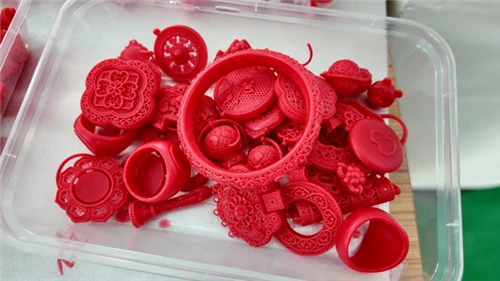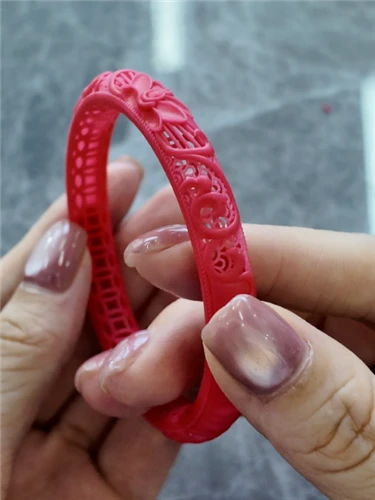
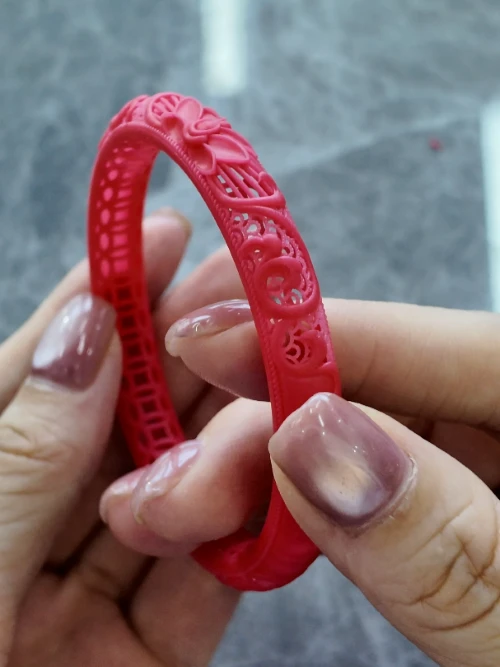
In the lost-wax casting processes used for high-end jewelry manufacturing, precision component production, and the creation of master patterns, manufacturers frequently encounter a persistent bottleneck: after being cleaned with traditional agents-such as alcohol, strong alkaline solutions, or industrial organic solvents-red wax patterns appear flawless, with smooth, mirror-like surfaces. Yet, once the final metal casting is poured and solidified, the finished pieces often reveal microscopic inclusions or pitting (sand-like defects) during the polishing stage, directly eroding the workshop's profit margins.
Comprehensive characterization-utilizing techniques such as micro-CT, SEM-EDS, XRD, FTIR, and GC-MS at the Center for Advanced Materials and Surface/Interfacial Chemistry-reveals that these defects are not merely a matter of alloy purity. Instead, they stem from residues of traditional chemical cleaning agents, which trigger "wax–slurry interfacial contamination" within the outer layers of the master wax pattern, subsequently leading to an "interfacial hydration anomaly."
I. The Microscopic Physicochemical Mechanism of "Wax–Slurry Interfacial Contamination"
During the Multi-Jet Printing (MJP) process, piezoelectric nozzles deposit micron-scale, true-wax organic esters (polymers). To remove the white, sacrificial support wax, it is common practice in many workshops to use high-concentration anhydrous ethanol or hydrocarbon solvents in an ultrasonic cleaning bath. During this process, small molecules from these potent chemical solvents inevitably penetrate the grain boundaries of the red master wax pattern. Due to the viscoelastic nature of the wax material and lattice adsorption effects, a residual solvent layer-invisible to the naked eye-forms on and within the surface of the wax. Once these seemingly clean wax patterns enter the plaster investment process, small chemical solvent molecules-lingering on the surface of the red wax-are released. These molecules trigger interfacial physicochemical reactions with the hydrated components of the plaster slurry:
Disruption of hydration kinetics: The hardening of plaster slurry is essentially the hydration and crystallization process in which hemihydrate gypsum (CaSO4·½H2O) converts into dihydrate gypsum (CaSO4·2H2O). The exuded alcohol or solvent molecules, being highly hydrophilic, compete for free water molecules at the interface, thereby altering the local water-to-plaster ratio.
Inhibition of interfacial nucleation and crystal growth: Solvent molecules adsorb onto the surfaces of the needle-like dihydrate gypsum crystals, hindering their nucleation and growth kinetics. Consequently, the mold wall surface-directly adjacent to the red wax-fails to develop a proper, interlocking crystalline structure. Upon hardening, the plaster at this interface becomes loose and porous at the microscopic scale, exhibiting a "pulverized" state with low shear strength.
II. Mold Wall Erosion, Spalling, and the Formation of Micro-Inclusions During Molten Metal Filling
The real catastrophe occurs the moment molten metal-at temperatures reaching thousands of degrees-is forced into the mold cavity under vacuum and pressure.
As the molten precious metal surges into the cavity at high velocity, the microscopically pulverized inner surface of the plaster mold is subjected to fluid shear forces, causing it to erode and spall off in micron-sized flakes. These dislodged plaster fragments mix with the high-temperature molten metal, creating intense, flow-obstructing turbulence and abnormal temperature gradients within the fluid boundary layer. Once the metal cools and solidifies, these plaster particles become trapped within the metallic matrix, forming deep-seated micro-inclusions and sand-inclusion defects. This significantly compromises the toughness and mechanical properties of the metal's microstructure.
III. Post-Processing via Warm-Water Dissolution: Mitigating Chemical Degradation of the Mold Cavity at the Source
To effectively control chemical contamination at the wax-slurry interface, a key process strategy involves minimizing the use of aggressive chemical solvents. This is achieved through an automated warm-water dissolution process, designed as an integral component of the industrial-grade MJP (Multi-Jet Printing) pure-wax additive manufacturing ecosystem.
The flagship mass-production system, Originator ORI 053-featuring a build volume of 290 × 207 × 138 mm and a resolution of up to 2,900 × 2,900 × 1,700 DPI-integrates complex polymer phase-change and dissolution behaviors into a closed-loop system comprising both the machine and its proprietary materials. The system utilizes a dual-material setup: high-purity red ORI-610 modeling wax and water-soluble white ORI-110 support wax. The high-contrast red-and-white color scheme facilitates visual quality inspection.
Following the printing process, operators can bypass the use of metal tools or hazardous chemical solvents; the entire build plate is simply submerged in warm water (38–42°C). Within this temperature range, the white ORI-110 support wax dissolves at the molecular level and detaches. Meanwhile, the red ORI-610 structural wax remains protected by the gentle, enveloping medium, ensuring it is free from mechanical abrasion or stress-induced deformation. Surface roughness can be maintained at the micron level (e.g., Ra ≤ 4 μm, depending on inspection standards and part geometry).
Because the primary red wax is not subjected to molecular-chain infiltration by aggressive chemical solvents, the risk of chemical residue is significantly reduced. During the investment (plaster-slurry) hardening phase, the slurry achieves more thorough and uniform hydration-crystallization against the surface of the red wax pattern. This results in a mold cavity with superior resistance to erosion by molten metal. During casting, the low flow resistance ensures smooth mold filling, which significantly lowers the risk of microscopic inclusions, cooling-induced cracks, and shrinkage porosity-particularly in thin-walled sections of the finished component. This automated workflow, which features full-process parameter traceability, consistently achieves an overall first-pass yield of over 96.1% under verified conditions. It empowers enterprises to build robust barriers-rooted in superior quality and production capacity-that are difficult for low-cost competitors to overcome.
III. Free Prototyping & Industry Collaboration
Originator 3D now offers free, large-scale prototyping services to precision casting manufacturers, mold-making firms, and high-end jewelry studios worldwide. This allows businesses to precisely evaluate edge tolerances and surface quality across the entire build plate using actual physical samples.
1-on-1 Prototyping Service (via CAD File Submission):
Master shrinkage anisotropy and reclaim workshop profit margins with 100% data-driven predictability: [Click here to add an official Originator 3D international sales representative]. Factories and studios requiring consistency verification for mass production are invited to send their CAD design files directly to our digital submission portal. Our headquarters will prioritize your project for printing on our new ORI 053 system, followed by post-processing using our standard 38–42°C warm-water dissolution process. We provide complimentary red-wax pattern printing; while we cover all material costs, please note that shipping for the finished prototypes is not included. Orders are processed in the sequence they are received-let physical results put an end to your quality-related concerns!
Media Contact & Corporate Gateway
Official Issuer: Originator 3D Global Application Engineering & Cross-Border Compliance Audit Center