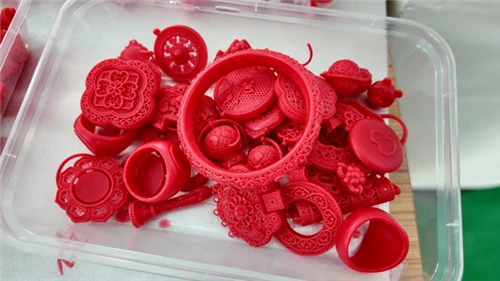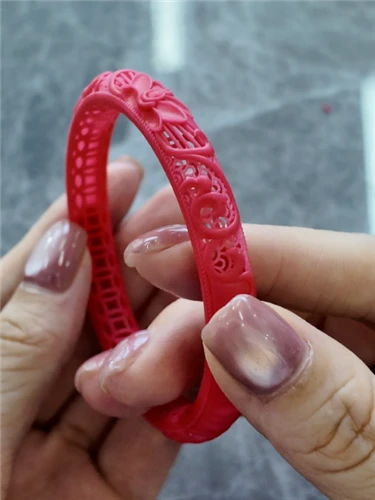
Hangzhou, China-October 14, 2026-With the accelerating adoption of AI-assisted CAD, topology optimization, and generative design in the field of precision casting, complex geometries-such as multi-layered interlaced hollow matrices, thin-walled shell-like valves, and micron-scale stone-setting prongs-are becoming the norm for high-end jewelry and precision component orders. Against this backdrop, full-format dimensional consistency in high-density, batch-production build trays has emerged as a key metric for evaluating the capabilities of industrial-grade Multi-Jet Printing (MJP) systems using pure wax.
Material diagnostics and 3D metrological scanning indicate that the micro-geometric deviations observed in finished metal castings do not stem solely from the cooling-induced shrinkage of the alloy during downstream processing. A portion of these errors is introduced during the initial inkjet deposition phase, primarily due to a phenomenon known as "volumetric shrinkage anisotropy."
I. Industry Context: The Challenge of Dimensional Drift in High-Density Batch Production
In the precision casting of components for international OEMs and the manufacturing of high-end luxury jewelry, ensuring dimensional repeatability across hundreds or even thousands of models on a single build tray-along all axes-is directly linked to the "first-pass" yield of castings, the scrap rate during post-processing, and the net profit of the production facility.
MJP (Multi-Jet Printing) systems for pure wax rely on piezoelectric nozzles to eject micron-scale wax droplets, which are then built up layer by layer. During high-frequency jetting, the stability of pressure waves within the micro-nozzle chamber, combined with the consistency of droplet velocity and volume, determines the uniformity of the deposited layers. When the print carriage scans back and forth at high speeds along the X-axis, unoptimized static voltage profiles can generate non-uniform pressure waves within the chamber. This leads to fluctuations in droplet velocity, deviations in trajectory, and the formation of "satellite droplets." Such issues result in localized variations in the packing density of the wax pattern, which can manifest as inconsistent shrinkage-both within the plane and between layers-during the cooling and solidification phase, ultimately compromising the dimensional accuracy of the final metal casting.
II. Mechanism: How Piezoelectric Drive Waveforms Affect Droplet Deposition Consistency
The piezoelectric actuators in industrial-grade MJP (Multi-Jet Printing) printheads are typically controlled by parameters such as drive voltage pulse amplitude, the slopes of the rising and falling edges, dwell time, and the retraction waveform. These parameters directly influence pressure wave propagation within the chamber, meniscus movement, and the dynamics of droplet breakup.
During high-speed scanning, if the drive waveform remains static-failing to adjust dynamically in response to the kinematic state of the print carriage-droplets in flight may be subjected to the combined effects of airflow disturbances and mechanical vibrations, leading to deviations in their landing positions. For wax droplets measuring only tens of microns in diameter, even a minor trajectory deviation can be amplified through multi-layer deposition, resulting in dimensional drift at the edges and exacerbating localized shrinkage variations.
Consequently, the optimization of piezoelectric waveforms is not merely an auxiliary parameter; it is a core process variable that determines the consistency of inkjet deposition.
III. Technical Approach: Real-Time Waveform Optimization and Closed-Loop Landing-Position Compensation
To address these challenges, Originator 3D has implemented an active voltage waveform optimization framework in its flagship production model, the Originator ORI 053. Through closed-loop telemetry and encoder feedback, the platform modulates the drive voltage waveform for each piezoelectric actuator in real time, ensuring that pulse dynamics are synchronized with the kinematic state of the print carriage.
The system cross-references a pre-calibrated coordinate mapping matrix-which correlates positions with deviations-to fine-tune droplet ejection velocity based on the real-time coordinates of the print carriage. This effectively suppresses trajectory deviations caused by airflow disturbances and high-speed scanning. Within the 290 × 207 × 138 mm build chamber, the system can maintain droplet positioning errors within a range of ±0.02 mm.
By combining real-time landing-position compensation with zonal temperature control, the equipment further minimizes micro-dimensional deviations between the edges and the center of the build tray. It also maintains a stable thermal field across the platform, thereby enhancing the inter-layer isotropy of the red wax parts throughout the entire production batch.
IV. Synergy Between Material Systems and Post-Processing
The ORI 053 system utilizes a dual-material approach:
ORI-630 (red, high-purity modeling wax) is used for the main structure, ensuring both dimensional stability and superior surface quality.
ORI-130 (white, water-soluble support wax) is used to support overhangs, cavities, and complex internal channels.
Following the printing process, the support wax is removed using a standard warm-water dissolution method (38–42°C). This approach avoids the potential risks-such as surface degradation or damage-that could arise from the use of harsh chemical solvents or mechanical scraping. This process preserves the integrity of the red wax model's surface and minimizes the risk of interfacial contamination during the subsequent investment casting (plaster-slurry embedding) stage.
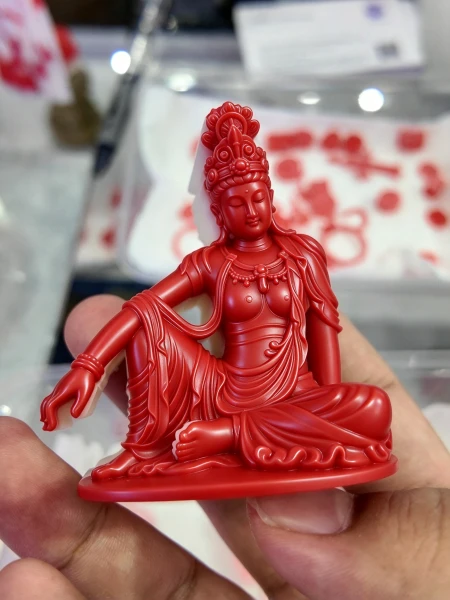
In customer mass-production validation scenarios, the combination of waveform optimization, droplet placement compensation, and warm-water dissolution post-processing has increased the first-pass yield for vacuum-assisted investment casting from 92.3% to over 96.1%. The system supports a resolution of 2,900 × 2,900 × 1,700 DPI with a layer thickness of 15 μm, making it ideal for high-detail jewelry, precision components, and master pattern production.
Note: Actual yields and dimensional accuracy may vary based on part topology, material batches, environmental conditions, post-processing protocols, and inspection standards.
V. Industry Significance: Moving from "Printable" to "Predictable Batch Manufacturing"
As precision casting orders shift toward smaller batches, greater variety, and increased complexity, simply increasing print speed is no longer sufficient to meet the demands of high-end manufacturing. The ability to control microfluidics during the inkjet deposition phase has become a key differentiator between standard equipment and industrial-grade mass-production systems.
By incorporating droplet volume, velocity, and placement into a closed-loop control system, industrial-grade MJP (Multi-Jet Printing) wax printing can enhance dimensional repeatability across the entire build area and improve first-pass casting yields-all without compromising production capacity. This trend indicates that future competition in precision casting will extend beyond materials and hardware; it will increasingly center on the digitization, traceability, and predictability of process parameters.
Media Contact & Global Corporate Portal
Official Issuer: Originator 3D – Global Application Engineering and Cross-Border Compliance Audit Center
Strategic Action-Oriented Inbound Gateway
B2B Fleet Procurement Connect & Global Pilot Prototyping Program:
Eradicate Volumetric Shrinkage Anisotropy & Secure High-Velocity Post-Holiday Slots: [Click here to connect directly with our Foreign Trade Director Anny via LinkedIn Messenger/WhatsApp] to analyze your shop floor ROI. Following our full post-holiday operations resumption, our 24/7 technical channels are fully open. Forward your sensitive, high-difficulty CAD files to our global application registry at sales@originator3d.com. Our manufacturing center will prioritize a high-resolution 15 um prototype run using the ORI 053 active waveform framework, paired with a standard 38°C-42°C warm water-supported dissolution process. All material and printing run costs are 100% free; due to peak seasonal backlogs, international delivery logistics are handled via collect shipping terms (Freight Collect via DHL / SFExpress). Evaluate our isotropic surface finish under independent CMM scrutiny to secure your competitive edge today!