Industry Insights | MJP Wax Printing and the Investment Casting Shell Process
Dimensional deviations and surface defects in brittle metal castings are often attributed to the subsequent alloy pouring stage. In practice, however, the root cause of these defects can often be traced back to an earlier phase: the removal of support materials and the surface treatment of the wax patterns. Using manual tools to remove support structures can introduce micro-scratches and localised stress, particularly on thin-walled sections or delicate features like prong settings. Furthermore, if solvent cleaning is incomplete, residues-such as release agents, oils, or dissolved wax-can impair the wettability of the wax pattern by the primary ceramic slurry (face-coat). The accumulation of oils, salts, or moisture at the interface between the wax pattern and the face-coat can lead to inadequate hardening, resulting in scabs, loose material, or debris within the mould cavity-ultimately increasing the risk of pitting, depressions, and micro-inclusions on the final casting.
For technical discussions regarding the batch removal of support materials or the control of the wax-shell interface, please contact our application engineering team: Request a technical consultation.
The Root of the Defect Chain: Manual Support Removal and Surface Residue
In the production of high-density MJP wax patterns, support wax is required to provide temporary structural integrity for overhangs, internal channels, and intricate features like prong settings. Traditional post-processing methods-relying on manual tool removal or inadequate solvent cleaning-carry inherent process risks:
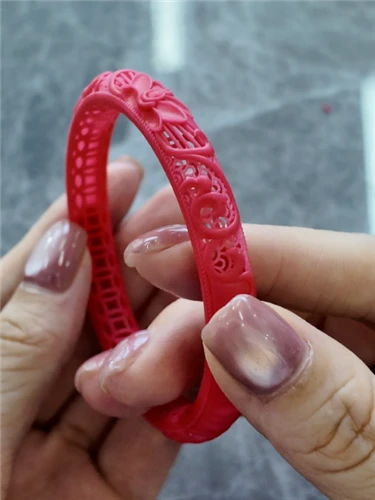
Manual removal of supports can cause micro-scratches and localised stress concentrations on thin-walled or delicate prong-like features, potentially leading to warping, deformation, or dimensional inaccuracies.
Incomplete solvent cleaning leaves residual release agents or oily substances on the wax pattern surface, which impairs the wettability and coating adherence of the primary ceramic slurry. This leads to uneven coating, poor adhesion, and potential shell defects.
The impact of these surface issues extends beyond mere appearance. Any oils, salts, or moisture remaining between the primary coating and the wax pattern can hinder the hardening process, resulting in surface irregularities-such as scabs, depressions, or residues-within the mould cavity. Ultimately, these manifest as pits, craters, or inclusions in the final cast parts.
Batch Removal of Support Structures: The Ethanol–PPG–Isopropanol Cleaning Process for the ORI 053 PLUS
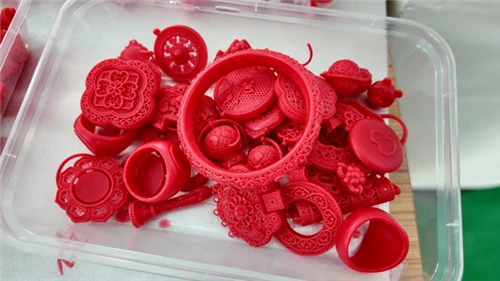
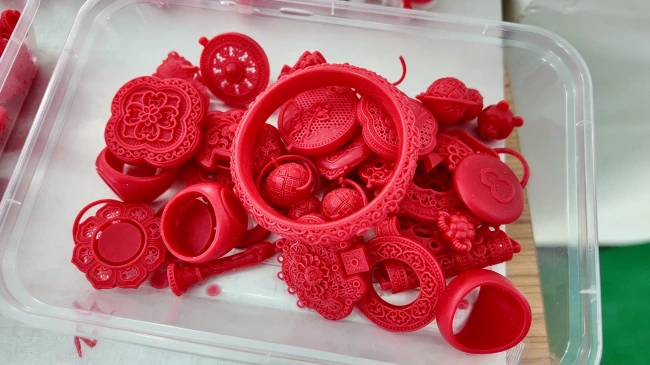
For the support material used with the Originator ORI 053 PLUS industrial-grade MJP wax-pattern system, a cleaning process utilising a combination of ethanol, polypropylene glycol (PPG), and isopropanol is employed. This process is specifically designed for complex geometries, including overhangs, internal channels, and intricate features like fine claw settings. The mixed solvent dissolves, penetrates, and detaches the support material, enabling batch cleaning that minimises the need for manual intervention and reduces the risk of mechanical damage to thin-walled or delicate features.
Because this stage involves an organic solvent system, the post-processing workflow requires precise control over solvent composition, cleaning temperature, duration, and the thoroughness of the drying phase. Compared to purely mechanical removal, this combined cleaning approach better preserves the integrity of complex geometric details. However, if drying is inadequate or the solvent ratio is incorrect, residual solvents may accumulate at the wax-slurry interface. Therefore, support removal is not merely a matter of "cleaning"; it is a critical step in managing the wax-to-shell interface. Standardising cleaning parameters helps to:
Minimise surface scratches and localised stress;
Reduce interference from residual solvents on the wettability of the primary ceramic slurry;
Prevent warping or deformation of thin-walled sections and delicate features;
Maintain the dimensional stability of the wax pattern prior to the shell-building process.
The platform integrates isotropic thermal control with closed-loop droplet placement compensation, ensuring consistent geometric accuracy for wax patterns across the entire build tray. In customer mass-production validation scenarios, when combined with standardised cleaning and post-processing protocols, this integrated process can achieve a first-pass yield (FPY) of 96.1% for investment casting. The exact figure may vary based on part geometry, wax material batches, solvent composition, casting processes, and inspection standards.
Why Controlling the Wax-Shell Interface Is Critical
In high-end jewellery, precision component manufacturing, and master pattern production, the surface condition of the wax pattern directly determines the quality of the primary coating's wetting, application, and hardening. If mould-release agents, oils, or dissolved wax residues remain on the wax pattern surface, the primary coating cannot adhere uniformly. This can lead to scabs, loose material, or debris on the inner surface of the ceramic shell-defects that cannot be rectified once the metal has solidified.
Transitioning from manual support removal to a standardised, batch-based solvent cleaning process reduces variability caused by operator differences. This ensures greater consistency in the surface condition of wax patterns before they enter the shell-building stage, making the casting process more predictable-even when handling complex geometries or mixed-product production runs.
Validate Your Wax Pattern Geometry and Interface Quality
If you are evaluating the consistency of batch solvent support removal, the quality of the wax-shell interface, or the dimensional repeatability of wax patterns across an entire build plate, we invite you to submit your CAD files for sample validation on the ORI 053 PLUS platform. Samples are produced using a standard MJP wax-printing process, with supports removed in bulk via a standardised ethanol–PPG–isopropanol cleaning process, including controlled solvent residue and drying parameters. Qualified validation requests may be eligible for coverage of material and printing costs; shipping costs are the responsibility of the recipient (freight collect).
👉 Submit your CAD files to request a free sample validation.
👉 Contact our Application Engineering Team.
Issued by: Originator 3D Global Application Engineering & Cross-Border Compliance Audit Center
Technical Enquiries: sales@originator3d.com
Note: Performance data may vary depending on part topology, wax material batches, solvent composition, environmental conditions, post-processing protocols, and measurement standards.