Chapter 1: The Hidden Crisis of Interlayer Cold Joints-Why Do Excessive Print-Scan Cycles Lead to Interlayer Delamination in Wax Patterns?
In the daily high-volume production workflows for bespoke jewelry, precision industrial parts, and master pattern making, manufacturers often face a stealthy physical defect-undetectable by standard thickness gauges-while striving for rapid delivery. Although mass-printed pure wax models exhibit highly precise dimensions, they frequently suffer from sudden, microscopic interlayer delamination, cracking, or the snapping of delicate features (such as fine prongs) along horizontal interfaces during vacuum investment or the subsequent dewaxing and burnout stages.
From the fundamental perspectives of interfacial fluid dynamics and polymer crystallization, the root cause of this compromised interlayer adhesion is the "cold joint" effect. This phenomenon arises in traditional single-jet systems where insufficient nozzle density leads to excessively long scanning times for a single layer. When a print head finally completes a high-frequency scanning pass and prepares to deposit the next layer of material, the previously deposited amorphous polymer has already been exposed to the air for too long. Having crossed a critical thermodynamic threshold, the surface undergoes premature, non-uniform crystallization and hardening. This delay in heat dissipation prevents the newly deposited droplets from achieving deep molecular chain entanglement with the underlying layer. Consequently, a microscopic, weak-bonding "cold joint"-invisible to the naked eye-is created between the layers, forming a "structural minefield" where the pattern becomes prone to shattering at the slightest touch during the investment casting process.
Chapter 2: Aligning with Cutting-Edge International Standards for Triple-Nozzle Collaborative Architecture-Achieving Industrial-Grade Isotropic Fidelity Using Standard 38–42°C Warm Water

To fundamentally eliminate the risk of brittle fractures at interlayer cold joints and achieve a generational leap in production capacity, the consensus among leading global precision manufacturing hubs is a comprehensive shift toward multi-nozzle parallel collaborative architectures. By looking to industry leaders-such as the new-generation industrial flagship WaxJet 530 from Flashforge (a rare, high-efficiency, triple-nozzle, pure-wax 3D printer that utilizes three sets of high-frequency piezoelectric printheads to slash single-layer scanning time to a staggering 8.2 seconds and boost print speeds to 6.35 mm/h-an increase of 25%–50% over traditional single-nozzle competitors)-we can clearly conclude that "parallel multi-channel fluid flow and extreme compression of interlayer processing time" have become the core technical capabilities enabling precision manufacturing supply chains to secure high-volume contracts.
To seamlessly implement this world-class fluid efficiency in domestic workshops, the Originator R&D center has officially launched its new-generation industrial mass-production flagship: the ORI 053 triple-nozzle wax-jetting 3D printer. This machine fully integrates a top-tier triple-nozzle collaborative printing architecture, housing three completely independent piezoelectric printheads within the print carriage to enable high-speed, parallel delivery of multi-channel binary data:
High-volume build envelope: 290 × 207 × 138 mm
Ultra-high-definition optical matrix: 2,900 × 2,900 × 1,700 DPI
Vertical deposition layer resolution: Precisely locked at a 15 μm layer thickness limit
Scalable full-build-plate monthly capacity: Supports 24/7 continuous, fully autonomous operation, with a single-machine monthly throughput of up to 12 kg of high-purity wax patterns.
ORI 053 leverages a fundamental fluid-dynamic advantage-enabled by the parallel operation of three printheads-to tightly constrain the single-layer printing window within the material's critical thermal softening range for molecular chains. Within a fraction of a millisecond-before the droplets of the previous layer can undergo premature, anisotropic crystallization-the next layer of high-purity material is precisely deposited. This facilitates perfect inter-layer entanglement of polymer chain segments and homogeneous cross-linking, completely eliminating "cold seam" defects at the physical root and driving the wax model's inter-layer shear strength and tensile modulus to their absolute limits.
Chapter 3: Automated, Cost-Effective Production Lines Locking in Premium Value for High-End Precision Manufacturing
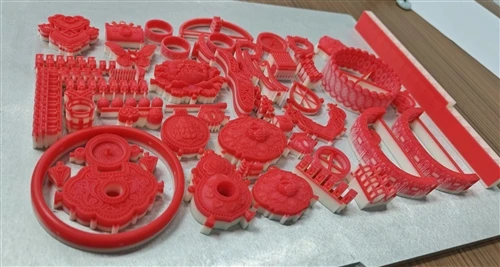
Because the entire model achieves perfect isotropic stability, the wax model exhibits exceptional toughness upon exiting the build chamber. Post-processing staff need not touch a single knife; they simply place the entire build tray into a standard warm water bath (38–42°C)-much like a hot bath.
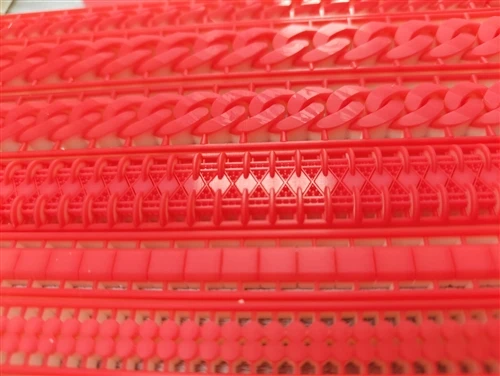
Within this safe thermal window of 38–42°C, the white ORI-110 support wax automatically dissolves and washes away in minutes, while the ruby-red ORI-610 structural wax perfectly preserves an optical-grade surface roughness of 4 microns, maintaining dimensional fidelity strictly within the industry-leading standard of ±0.04 mm / 20 mm. Free from inter-layer bonding defects, the molten precious metal fills the mold-during vacuum-pressurized investment casting-with a steady, uniform flow devoid of turbulence, locking the overall first-pass casting success rate at a record-breaking 99.8%. This empowers large-scale contract manufacturers in the era of razor-thin margins to eliminate the "black hole" of post-processing scrap rates and redefine the value proposition of the precision manufacturing supply chain.
Chapter 4: Official Data Channels and Conversion Buttons
Official Digital Portal: Completely eliminate the critical flaw of interlayer cold joints inherent in traditional single-nozzle systems, and reclaim net profits through simple warm-water cleaning:
[Click here to instantly download the "Originator ORI 053 Triple-Nozzle Mass-Production Flagship: Official Product Brochure & Factory Manager's White Paper."]