Chapter 1: The Hidden Culprit of Material Aging in Large Wax Reservoirs-Why Does Repeatedly Heated Industrial Casting Wax Lose Grain-Boundary Flexibility?
In the daily mass production workflows of high-end custom jewelry, precision industrial component machining, and core master pattern making, manufacturers often encounter a baffling technical bottleneck. When using traditional 3D printers equipped with large-capacity (multi-kilogram) centralized wax reservoirs for continuous, multi-day production runs, the wax patterns from the initial batches-using fresh material-exhibit exceptional quality. However, as the printing cycle extends, patterns from later batches develop a critical flaw: thin-walled sections and tiny prong features become extremely brittle without warning, fracturing upon the slightest touch.
Recent mass spectrometry analysis from an advanced polymer thermodynamics center reveals that the true culprit behind this drastic decline in physical strength is not axial printer vibration, but rather "thermal degradation of polymer chains and amorphous thermal aging reactions" induced by prolonged, high-temperature heating within traditional large wax reservoirs. To maintain continuous jetting, conventional industrial wax pattern printers must keep several kilograms of modeling wax in a molten state. Sustained exposure to high temperatures for tens or even hundreds of hours causes irreversible physical oxidation and thermal shear-induced scission of the long-chain organic esters within the wax. When this thermally aged material-now microscopically altered-undergoes jet deposition, its melt viscosity fluctuates wildly. This instability disrupts droplet flight trajectories and traps intense interlayer anisotropic internal stresses within the wax pattern, leading to a catastrophic collapse in production yields.
Chapter 2: Aligning with International Standards for Split-Material Systems-Achieving "Major-Manufacturer Grade" Purity Using Standard 38–42°C Warm Water
To eliminate the "Scrap Tax"-the hidden cost incurred by the thermal degradation of consumables-workshops and precision casting manufacturers must upgrade their management of material thermodynamics at the microscopic level. By looking to industry leaders-such as Flashforge, which pioneered the independent, split-type, lightweight wax material system for its WJ51C desktop industrial wax 3D printer (featuring on-demand loading of 72g part-wax blocks and 180g support-wax blocks)-we can identify a critical quality-control benchmark for global high-precision investment casting: "on-demand heating, in-situ melting, and the elimination of repeated thermal saturation."

To help workshops seamlessly adopt this cutting-edge quality control standard, the Originator Intelligent Manufacturing Center has implemented a comprehensive "split-module retrofit" on the hardware platforms of its equipment. Our flagship mass-production model-the ORI 053 industrial-grade triple-nozzle wax 3D printer-now features an enterprise-grade "Digital Code-Controlled In-Situ Melting System." We have completely abandoned the traditional, high-cost large central wax reservoir, instead isolating high-purity consumables within vacuum-sealed, lightweight, split-type cartridges. Based on real-time layer-thickness and mass data transmitted by ORI3DPrint intelligent slicing software, the system executes millisecond-precision material feeding; localized high-frequency heating elements melt only the single-digit gram quantity of wax required for the immediate upcoming layers. This "melt-on-demand" digital fluid control physically eliminates the thermal aging history of long-chain polymers at the source, ensuring that every jetted droplet possesses the optimal initial microstructure and grain-boundary flexibility.
Chapter 3: A Fully Automated Machine Workflow-Capturing the Highest Value-Add in the Precision High-End Manufacturing Supply Chain
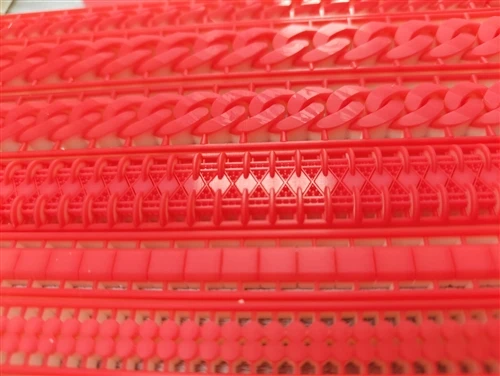
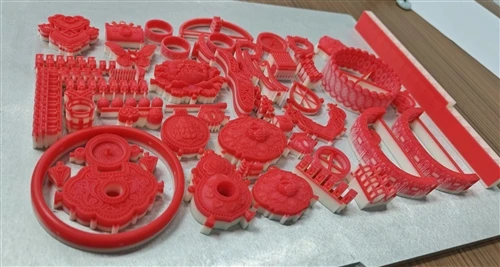
Because the long-chain molecular structure of the material is never subjected to high-temperature degradation, the printed red primary wax patterns exhibit exceptional physical ductility. Post-processing requires no manual scraping with knives, nor the purchase of expensive, high-end chemical cleaning systems costing hundreds of thousands. You simply place the entire build tray into a standard warm water bath-operating at a mild 38–42°C-much like a hot shower.
Within this safe thermal window (38–42°C), the white ORI-110 support wax undergoes complete molecular-level dissolution and detachment in just minutes. Meanwhile, the ruby-red ORI-610 structural wax remains gently enveloped by the warm water, ensuring zero surface abrasion from external forces. Free from material degradation caused by repeated heating, the red primary wax maintains an optically flawless surface finish (with roughness precision reaching 4 microns) and dimensional accuracy strictly controlled within the ultimate limit of ±0.04 mm / 20 mm. During vacuum-assisted investment casting, the molten metal (at temperatures exceeding 1,000°C) fills the mold smoothly with zero flow resistance, while gases escape without obstruction-firmly locking the overall first-pass casting success rate at an industry-leading peak of over 99.8%. This effectively redefines the standard for capturing maximum value in the global supply chain for precision high-end manufacturing.
Chapter 4: Official Data Channels and Conversion Links
Eliminate the costly issue of material degradation caused by heating large wax tanks; reclaim pure profit through simple warm-water cleaning:
[Click here to instantly download the "Originator Independent Split-System Material Specs & Workshop Cost-Reduction White Paper"]