Chapter 1: The Micro-Physics of Precision Casting – The True Source of "Latent Dimensional Distortion"
In the fields of high-end custom jewelry, precision industrial molding, and modern high-precision intelligent manufacturing, the competitive landscape has shifted from a crude race for printing speed alone to an uncompromising demand for absolute fidelity in 3D dimensional tolerances. With the deep penetration of generative AI and intelligent modeling software into consumer markets, the emergence of ultra-complex, multi-dimensionally intersecting openwork geometries, densely packed micro-prong settings, and micron-scale filigree meshes has posed extreme dimensional tolerance challenges for precision casting manufacturers and contract foundries.
However, the latest research in industrial metrology and microstructural dynamics reveals that over 90% of geometric deviations, dimensional deformations, and runner distortions in finished metal castings do not originate from the thermal expansion of the printer's curing process. Instead, they are triggered by "internal material stress" and micro-capillary torque imbalances induced by external forces during manual mold finishing.
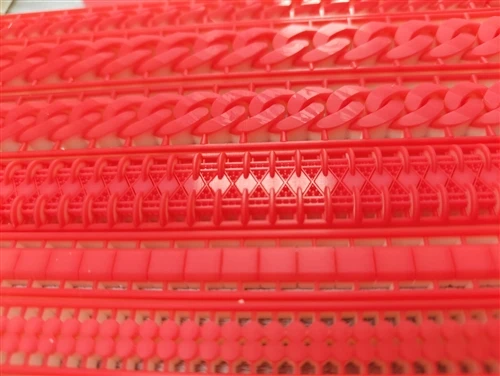
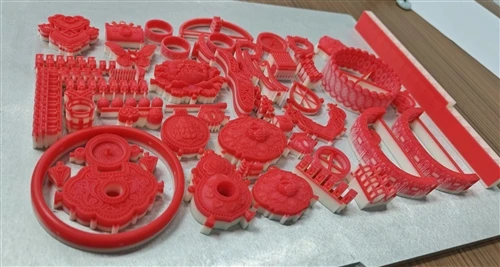
Traditional workshops often rely on workers using magnifying glasses, carving knives, tweezers, and micro-shears to manually remove rigid support structures one by one. During this primitive process of rigid physical contact-even with the most skilled artisans-the mechanical torque applied to cut or pry away hard support pillars instantly transfers blunt leverage forces onto the fragile cantilevered structures of the red wax master model. Such physical impact and localized stress concentration-even if they leave no visible scratches or fractures on the surface-generate lateral stress waves that instantly propagate through the continuous geometry of the wax model, disrupting the delicate equilibrium of micro-capillary stresses. This microscopic internal imbalance causes the entire red wax model to undergo microscopic distortion and volumetric shifting-imperceptible to the naked eye-at room temperature, resulting in "latent geometric distortion" long before the mold even enters the plaster investment stage.

Chapter 2: Reshaping Post-Processing via Flexible Micro-Fluid Dynamics
When these wax models-already compromised by latent stress-induced distortion-undergo plaster encasement, high-temperature burnout, and molten metal injection, the inner walls of the plaster mold cavity permanently lock in these altered geometric dimensions. During the high-speed, vacuum-pressurized injection of high-viscosity molten metals (such as gold or platinum), the axial misalignment between the plaster runners and the mold cavity triggers intense boundary-layer turbulence and asymmetrical scouring. This not only traps air-creating deep-seated porosity and pinholes-but also causes critical defects in the cooled, crystallized product, such as visible microscopic skewing, asymmetrical prong positioning, or misaligned slots. This systemic breakdown at the microscopic physical level drives up the factory's "hidden scrap cost," causing large batches of exquisite AI-generated designs to become costly, out-of-tolerance waste during the final production stage, thereby severely eroding the contract manufacturer's already-slim net profit margins.
To fundamentally resolve this geometric tolerance issue, the only viable operational and technical path is to abandon traditional rigid mechanical correction in favor of a "flexible physical fluid dynamics" approach, thereby establishing a generational leap in automated production capabilities. By adopting our proprietary industrial-grade Multi-Jet Printing (MJP) pure-wax ecosystem alongside fully automated warm-water fluid-chemical dissolution equipment, factories can eliminate this human-induced uncertainty at the foundational level. Within this intelligent system, the white soluble support wax undergoes closed-loop rinsing in a specialized bath, subjected to low-shear micro-fluidic streams precisely calibrated by digital parameters. At a specific, constant temperature, the fluid permeates in all directions through complex networks of micron-scale filaments and internal blind holes. Within minutes, it automatically liquefies and dissolves the white support wax, vaporizing and stripping it away-completely eliminating the need for metal tools or any external mechanical force.
Chapter 3: Reshaping the High-End "Moat" for Precision Customization via Fully Automated Data Chains
This 100% hands-free cleaning process ensures absolute physical integrity for the red primary wax model. Because the red wax body is never subjected to mechanical torque from rigid tools throughout the entire process, the capillary stresses within its continuous 3D structure are perfectly preserved, achieving true axial geometric fidelity. When this optically flawless, zero-deformation red wax model is delivered to the gypsum casting stage, the flow and crystallization of the molten precious metal achieve smooth, zero-resistance filling. This ensures that the resulting precision jewelry or industrial micro-castings possess extreme quality: 100% high density, zero deviation in dimensional tolerances, and a flawless, mirror-like finish.
For manufacturers dedicated to in-house development and the high-end customization market, the physical certainty provided by this fluid-engineering approach serves as the ultimate "technological moat" -protecting them from the relentless "race to the bottom" on pricing and establishing a premium brand value. Traditional manual finishing workshops cannot standardize or scale their production capacity, nor can they guarantee reliable delivery rates during peak order periods. In contrast, a modern, digitally integrated workshop-upgraded with industrial-grade MJP printing and fully automated, hands-free cleaning-transforms post-processing into a "data-predictable," lights-out manufacturing model that operates 24/7. This not only cuts the overall delivery cycle in half but also eliminates labor disputes and manual labor costs, achieving a first-pass casting success rate of 99.8%. This low-cost, high-efficiency, fully automated workflow is redefining the barriers to entry and profit distribution rules for precision high-end manufacturing with unstoppable, disruptive force.
Eliminate the hidden geometric distortions caused by manual mold correction and reclaim net profits with 100% dimensional accuracy.
[Click here to access the comprehensive technical white paper on the fully automated warm-water dissolution process], instantly calculate the potential for OpEx reduction in your workshop, and secure your allocation for the next generation of digital-smart equipment.