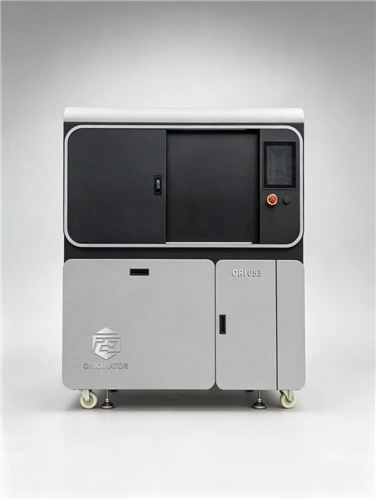
Compared to traditional wax model making, wax 3D printing technology offers significant advantages such as high precision, high efficiency, greater design freedom, controllable costs, and good batch consistency, making it particularly suitable for precision casting and personalized customization.
Core Advantages Explained
Ultra-high Precision and Detail Reproduction Capability: Wax 3D printing can achieve layer thickness accuracy of ±0.025 mm, accurately reproducing micron-level details, such as openwork patterns in jewelry, occlusal surface textures in dental models, and biomimetic structures in medical devices. DLP and MJP processes even support resolutions of 2400×1800×1800 dpi, far exceeding the limits of hand-carved wax.
Significantly Improved Production Efficiency: The design-to-finish cycle is shortened by more than 70%. No mold making or modification is required; printing can begin directly after CAD model confirmation, with dozens of wax models produced in a single batch. For example, the MJP 300W Plus can print approximately 222 wax models in as little as 9.5 hours, greatly improving delivery speed. High degree of design freedom: Unrestricted by traditional processes, it can easily realize complex geometric shapes such as hollow structures, nested gears, fine meshes, and topology optimization. Designers only need to model in the software to output the complete design, truly achieving "what you imagine is what you get."
Reduced overall production costs: Although the initial equipment investment is higher, it eliminates the costs of mold development, manual carving, and trial and error modifications. High material utilization, with detachable or dissolvable supports, reduces grinding losses, offering a significant cost advantage, especially in small-batch, multi-batch production.